Showing posts with label Bacteriology. Show all posts

Pigment producing pathogenic bacteria:

Pseudomonas species 
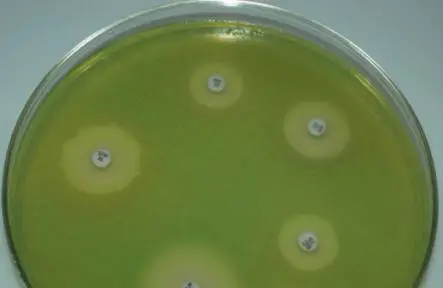
Pseudomonas aeruginosa growing on Mueller Hinton Agar
Pseudomonas aeruginosa (green color) growing on Mueller Hinton Agar
Pseudomonas aeruginosa is a leading bacterial pathogen in hospital settings and for immunocompromised patients (those with underlying conditions such as neutropenia, burns or cystic fibrosis). P. aeruginosa ( aeruginosa, which derives from a Latin word denoting the color of copper rust) produces a green fluorescent pigment (fluorescein/pyoverdin) and a blue pigment (pyocyanin). These pigments impart greenish hue to the sputum of cystic fibrosis patients with chronic lung infection,  gives colonies and infected wound dressings a greenish-blue coloration.
P. aeruginosa is usually recognized by the pigments it produces and the distinctive smell of cultures. . When the culture is left at room temperature, pigment colour becomes more intense.  A minority of strains are non-pigment producing.
Other species of Pseudomonas (such as P.fluorescens and P. putida) also produce pigments.
Serratia
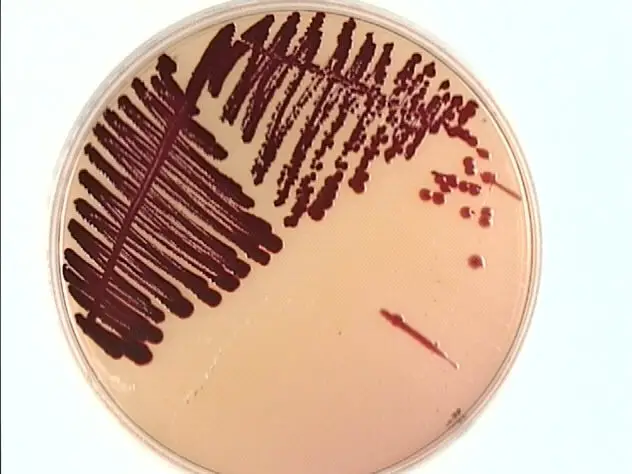
Red colored colonies of Serratia marcescens in MacConkey Agar (Source University of Maryland)
Red colored colonies of Serratia marcescens in MacConkey Agar (Source University of Maryland)
Serratia marcescens (mneomonic: Mars is red) is notable for its production of a bright red pigment called “prodigiosin”. Some strains produce a red pigment in nutrient agar at room temperature

Staphylococcus aureus
Staphylococcus aureus (aureus = “golden”, Latin) produces multiple carotenoid pigments, one being golden yellow pigment (Staphyloxanthin). When cultured on sheep blood agarS. aureus can be differentiated from other beta-hemolytic cocci by elaboration of golden pigment. Pigment is less pronounced in young colonies.

Violacein from Chromobacterium violaceum
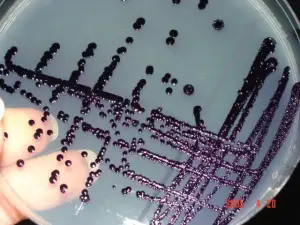
Characteristics pigment production by Chromobacterium violaceum
Characteristics pigment production byChromobacterium violaceum
Chromobacterium violaceum, an agent of localized skin infection or localized lymphadenitis which occasionally causes fatal septicemia elaborates a blue-violet pigment, violacein.
Group B Streptococcus
Group B Streptococcus (GBS), the leading etiologic cause of severe neonatal bacterial infection, expresses an orange-red pigment, called granadaene. This Orange pigment is produced by Streptococcus agalactiae when cultured on serum starch agar anaerobically.
Iron porphyrin of Porphyromonas gingivalis
Porphyromonas gingivalis is  a gram negative anaerobic bacilli, which is implicated in the pathogenesis of certain forms of periodontal disease. Arginine- and lysine-specific gingipain proteases of P. gingivalis degrade hemoglobin to release iron (III) protoporphyrin IX , which is dimerized to form the micro-oxo bis-haem-containing black pigment of the organism.
Nontuberculous Mycobacteria
The genus Mycobacterium includes many bacteria that produce pigments. . The Runyon classification systemgroups mycobacteria based on growth rate and pigment production in the presence of light or dark. M. tuberculosis is a nonchromogen, i.e. it does not produce pigment in light or darkness

Fungal pathogens which produce pigments

Aspergillus fumigatus is a filamentous fungus that elaborates a melanin-like substance during its conidial stage of growth.
Cryptococcus neoformans is an encapsulated yeast-like fungus that produces a brown or black melanin pigment by conversion of diphenols or homogentisic acid this coloration can be used for rapid identification of colonies on cornmeal agar, a medium commonly used in yeast isolation
Penicillum marneffei is an opportunistic pathogen causing systemic penicilliosis in AIDS patients. It produces characteristic red pigment in Sabouraud dextrose agar.

Pigment producing pathogenic bacteria:

Pseudomonas species 
Pseudomonas aeruginosa growing on Mueller Hinton Agar
Pseudomonas aeruginosa (green color) growing on Mueller Hinton Agar
Pseudomonas aeruginosa is a leading bacterial pathogen in hospital settings and for immunocompromised patients (those with underlying conditions such as neutropenia, burns or cystic fibrosis). P. aeruginosa ( aeruginosa, which derives from a Latin word denoting the color of copper rust) produces a green fluorescent pigment (fluorescein/pyoverdin) and a blue pigment (pyocyanin). These pigments impart greenish hue to the sputum of cystic fibrosis patients with chronic lung infection,  gives colonies and infected wound dressings a greenish-blue coloration.
P. aeruginosa is usually recognized by the pigments it produces and the distinctive smell of cultures. . When the culture is left at room temperature, pigment colour becomes more intense.  A minority of strains are non-pigment producing.
Other species of Pseudomonas (such as P.fluorescens and P. putida) also produce pigments.
Serratia
Red colored colonies of Serratia marcescens in MacConkey Agar (Source University of Maryland)
Red colored colonies of Serratia marcescens in MacConkey Agar (Source University of Maryland)
Serratia marcescens (mneomonic: Mars is red) is notable for its production of a bright red pigment called “prodigiosin”. Some strains produce a red pigment in nutrient agar at room temperature

Staphylococcus aureus
Staphylococcus aureus (aureus = “golden”, Latin) produces multiple carotenoid pigments, one being golden yellow pigment (Staphyloxanthin). When cultured on sheep blood agarS. aureus can be differentiated from other beta-hemolytic cocci by elaboration of golden pigment. Pigment is less pronounced in young colonies.

Violacein from Chromobacterium violaceum
Characteristics pigment production by Chromobacterium violaceum
Characteristics pigment production byChromobacterium violaceum
Chromobacterium violaceum, an agent of localized skin infection or localized lymphadenitis which occasionally causes fatal septicemia elaborates a blue-violet pigment, violacein.
Group B Streptococcus
Group B Streptococcus (GBS), the leading etiologic cause of severe neonatal bacterial infection, expresses an orange-red pigment, called granadaene. This Orange pigment is produced by Streptococcus agalactiae when cultured on serum starch agar anaerobically.
Iron porphyrin of Porphyromonas gingivalis
Porphyromonas gingivalis is  a gram negative anaerobic bacilli, which is implicated in the pathogenesis of certain forms of periodontal disease. Arginine- and lysine-specific gingipain proteases of P. gingivalis degrade hemoglobin to release iron (III) protoporphyrin IX , which is dimerized to form the micro-oxo bis-haem-containing black pigment of the organism.
Nontuberculous Mycobacteria
The genus Mycobacterium includes many bacteria that produce pigments. . The Runyon classification systemgroups mycobacteria based on growth rate and pigment production in the presence of light or dark. M. tuberculosis is a nonchromogen, i.e. it does not produce pigment in light or darkness

Fungal pathogens which produce pigments

Aspergillus fumigatus is a filamentous fungus that elaborates a melanin-like substance during its conidial stage of growth.
Cryptococcus neoformans is an encapsulated yeast-like fungus that produces a brown or black melanin pigment by conversion of diphenols or homogentisic acid this coloration can be used for rapid identification of colonies on cornmeal agar, a medium commonly used in yeast isolation
Penicillum marneffei is an opportunistic pathogen causing systemic penicilliosis in AIDS patients. It produces characteristic red pigment in Sabouraud dextrose agar.

Pigment producing pathogenic bacteria:

Pseudomonas species 
Pseudomonas aeruginosa growing on Mueller Hinton Agar
Pseudomonas aeruginosa (green color) growing on Mueller Hinton Agar
Pseudomonas aeruginosa is a leading bacterial pathogen in hospital settings and for immunocompromised patients (those with underlying conditions such as neutropenia, burns or cystic fibrosis). P. aeruginosa ( aeruginosa, which derives from a Latin word denoting the color of copper rust) produces a green fluorescent pigment (fluorescein/pyoverdin) and a blue pigment (pyocyanin). These pigments impart greenish hue to the sputum of cystic fibrosis patients with chronic lung infection,  gives colonies and infected wound dressings a greenish-blue coloration.
P. aeruginosa is usually recognized by the pigments it produces and the distinctive smell of cultures. . When the culture is left at room temperature, pigment colour becomes more intense.  A minority of strains are non-pigment producing.
Other species of Pseudomonas (such as P.fluorescens and P. putida) also produce pigments.
Serratia
Red colored colonies of Serratia marcescens in MacConkey Agar (Source University of Maryland)
Red colored colonies of Serratia marcescens in MacConkey Agar (Source University of Maryland)
Serratia marcescens (mneomonic: Mars is red) is notable for its production of a bright red pigment called “prodigiosin”. Some strains produce a red pigment in nutrient agar at room temperature

Staphylococcus aureus
Staphylococcus aureus (aureus = “golden”, Latin) produces multiple carotenoid pigments, one being golden yellow pigment (Staphyloxanthin). When cultured on sheep blood agarS. aureus can be differentiated from other beta-hemolytic cocci by elaboration of golden pigment. Pigment is less pronounced in young colonies.

Violacein from Chromobacterium violaceum
Characteristics pigment production by Chromobacterium violaceum
Characteristics pigment production byChromobacterium violaceum
Chromobacterium violaceum, an agent of localized skin infection or localized lymphadenitis which occasionally causes fatal septicemia elaborates a blue-violet pigment, violacein.
Group B Streptococcus
Group B Streptococcus (GBS), the leading etiologic cause of severe neonatal bacterial infection, expresses an orange-red pigment, called granadaene. This Orange pigment is produced by Streptococcus agalactiae when cultured on serum starch agar anaerobically.
Iron porphyrin of Porphyromonas gingivalis
Porphyromonas gingivalis is  a gram negative anaerobic bacilli, which is implicated in the pathogenesis of certain forms of periodontal disease. Arginine- and lysine-specific gingipain proteases of P. gingivalis degrade hemoglobin to release iron (III) protoporphyrin IX , which is dimerized to form the micro-oxo bis-haem-containing black pigment of the organism.
Nontuberculous Mycobacteria
The genus Mycobacterium includes many bacteria that produce pigments. . The Runyon classification systemgroups mycobacteria based on growth rate and pigment production in the presence of light or dark. M. tuberculosis is a nonchromogen, i.e. it does not produce pigment in light or darkness

Fungal pathogens which produce pigments

Aspergillus fumigatus is a filamentous fungus that elaborates a melanin-like substance during its conidial stage of growth.
Cryptococcus neoformans is an encapsulated yeast-like fungus that produces a brown or black melanin pigment by conversion of diphenols or homogentisic acid this coloration can be used for rapid identification of colonies on cornmeal agar, a medium commonly used in yeast isolation
Penicillum marneffei is an opportunistic pathogen causing systemic penicilliosis in AIDS patients. It produces characteristic red pigment in Sabouraud dextrose agar.

Pigment producing pathogenic bacteria:

Pseudomonas species 
Pseudomonas aeruginosa growing on Mueller Hinton Agar
Pseudomonas aeruginosa (green color) growing on Mueller Hinton Agar
Pseudomonas aeruginosa is a leading bacterial pathogen in hospital settings and for immunocompromised patients (those with underlying conditions such as neutropenia, burns or cystic fibrosis). P. aeruginosa ( aeruginosa, which derives from a Latin word denoting the color of copper rust) produces a green fluorescent pigment (fluorescein/pyoverdin) and a blue pigment (pyocyanin). These pigments impart greenish hue to the sputum of cystic fibrosis patients with chronic lung infection,  gives colonies and infected wound dressings a greenish-blue coloration.
P. aeruginosa is usually recognized by the pigments it produces and the distinctive smell of cultures. . When the culture is left at room temperature, pigment colour becomes more intense.  A minority of strains are non-pigment producing.
Other species of Pseudomonas (such as P.fluorescens and P. putida) also produce pigments.
Serratia
Red colored colonies of Serratia marcescens in MacConkey Agar (Source University of Maryland)
Red colored colonies of Serratia marcescens in MacConkey Agar (Source University of Maryland)
Serratia marcescens (mneomonic: Mars is red) is notable for its production of a bright red pigment called “prodigiosin”. Some strains produce a red pigment in nutrient agar at room temperature

Staphylococcus aureus
Staphylococcus aureus (aureus = “golden”, Latin) produces multiple carotenoid pigments, one being golden yellow pigment (Staphyloxanthin). When cultured on sheep blood agarS. aureus can be differentiated from other beta-hemolytic cocci by elaboration of golden pigment. Pigment is less pronounced in young colonies.

Violacein from Chromobacterium violaceum
Characteristics pigment production by Chromobacterium violaceum
Characteristics pigment production byChromobacterium violaceum
Chromobacterium violaceum, an agent of localized skin infection or localized lymphadenitis which occasionally causes fatal septicemia elaborates a blue-violet pigment, violacein.
Group B Streptococcus
Group B Streptococcus (GBS), the leading etiologic cause of severe neonatal bacterial infection, expresses an orange-red pigment, called granadaene. This Orange pigment is produced by Streptococcus agalactiae when cultured on serum starch agar anaerobically.
Iron porphyrin of Porphyromonas gingivalis
Porphyromonas gingivalis is  a gram negative anaerobic bacilli, which is implicated in the pathogenesis of certain forms of periodontal disease. Arginine- and lysine-specific gingipain proteases of P. gingivalis degrade hemoglobin to release iron (III) protoporphyrin IX , which is dimerized to form the micro-oxo bis-haem-containing black pigment of the organism.
Nontuberculous Mycobacteria
The genus Mycobacterium includes many bacteria that produce pigments. . The Runyon classification systemgroups mycobacteria based on growth rate and pigment production in the presence of light or dark. M. tuberculosis is a nonchromogen, i.e. it does not produce pigment in light or darkness

Fungal pathogens which produce pigments

Aspergillus fumigatus is a filamentous fungus that elaborates a melanin-like substance during its conidial stage of growth.
Cryptococcus neoformans is an encapsulated yeast-like fungus that produces a brown or black melanin pigment by conversion of diphenols or homogentisic acid this coloration can be used for rapid identification of colonies on cornmeal agar, a medium commonly used in yeast isolation
Penicillum marneffei is an opportunistic pathogen causing systemic penicilliosis in AIDS patients. It produces characteristic red pigment in Sabouraud dextrose agar.

Physiological Grouping
Acid producers
The organisms capable of fermenting lactose to form lactic acid are known as acid producers. Lactic acid coagulates milk by producing precipitation of Casein at 4.6 pH.
Homofermenters: Lactococcus, few Lactobacilli
Heterofermenters: Few Lactobacilli, Lueconostoc spp.,
LAB are classified as heterotrophic chemoorganotrophs i.e. these require the preformed carbon and energy sources. LAB lack cytochrome and cannot use respiratory pathway for energy generation. LAB generally lack metabolic diversity and mainly relies on two types of fermentation for the metabolism of sugars that form the basis of their taxonomic characterization. Based on Embden Meyerhoff Pathway and Phosphoketolase pathways LAB are classified as follows:
·         Homofermentative LAB: These Homofermentative LAB group use Embden Meyerhoff Pathway for hexose sugars utilization and produce 2 pyruvate and 2 ATP molecules. Pyruvate is further converted to lactic acid by the enzyme lactate dehydrogenase and is the only end product. However, under certain conditions the homofermenters can also undergo heterolactic fermentation. For example: during pentose sugar fermentation by LAB.
·         Heterofermentative LAB: This group of bacteria catabolise hexose sugars by Phosphoketolase Pathway and produce an equal amount of lactic Acid, carbon dioxide, acetate and ethanol as the major end products.
·         During this process only one ATP molecule is produced.
Gas producers
Gas producers are the organisms capable of producing CO2 or \ and H2 from lactose fermentations (e.g. E. coli, yeasts, and Clostridium spp.).
Proteolytic
Proteolytic organisms degrade milk proteins into soluble components by enzymes known as proteinases or proteases (e.g. Bacillus spp, Pseudomonas spp.).
Lipolytic
Lipolytic organisms are capable of attacking milk fat by enzymes such as lipases liberating glycerides and fatty acids (e.g. Pseudomonas spp, Achromobacter lipolyticum.
Moulds: Geotrichum candidum, Penicillium roqueforti).
Sweet curdling
Organisms capable of causing curdling of milk by rennin like enzyme before the development of sufficient acidity are known as sweet curdling organisms (e.g. B. subtilis, B. Cereus and Enterococcus liquefaciens).
Ropiness
Ropiness organism produce change in the viscosity of milk or forming threads when the milk is poured from one container to other, due to production of gums, mucins etc. (e.g. Alcaligenes viscosus).
Flavour producing
Many organisms are capable of producing different flavours in milk during their growth. Some of the flavours and associated organisms are listed below:
Fruity Pseudomonas fragi
Malty Lactococcus lactis subsp. lactis biovar maltigenes
Fishy Proteus icthyosmius
Unclean E. coli
Colour fermentations
Many organisms are capable of producing different colours in milk during their growth by producing chromogenic compounds. Some of the colours and associated organisms are listed below:
Yellow:          Pseudomonas synxantha
Blue:              Pseudomonas cyanogenes
Green:            Penicillium roqueforti
Black:             Pseudomonas nigrifaciens


Powered by Blogger.

Visitors

Print Friendly Version of this pagePrint Get a PDF version of this webpagePDF


 download University Notes apps for android

Popular Posts

Flag Counter